

Posted by Stephen Head on 21st Dec 2025
Quality Over Quantity: Why Mass Production Has a Ceiling Handcrafted Instruments Don’t Have
Most people think of mass production as a breakthrough that made life easier for consumers. And in many ways, it did. Before machinery and assembly lines, almost everything was made by hand. That meant slower output, higher cost, and limited availability. When factories came along, prices came down and certain products became accessible to almost everyone. That part of the story deserves credit.

But that wasn’t the only purpose of mass production.
It was also developed to widen margins for the producer.
When you can build thousands of units instead of a handful, the cost per unit drops. Labor gets spread thin. Materials get replaced by options that are easier to machine at scale. The price the customer pays goes down, but the profit per unit often goes up by an even larger margin.
That’s the side of the equation people tend to forget.
And it directly affects the quality of the products we use every day.
When speed and volume become the goal, the ceiling for quality changes.
Not because factories don’t care, but because the system they operate in has limits. Mass production can reach “good.” It can reach “acceptable.” It can reach “consistent.” What it cannot reach is the level of refinement that happens when someone is free to slow down, evaluate the material in front of them, and make adjustments that don’t fit neatly into an assembly-line schedule.
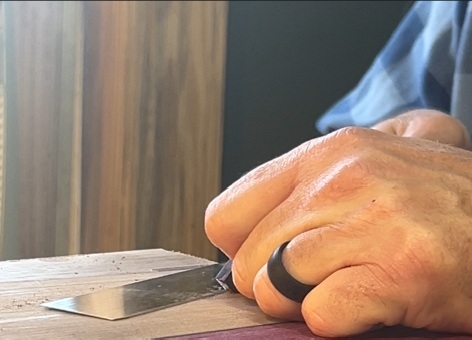
That’s the difference you hear and feel with handcrafted musical instruments.
Instruments aren’t disposable goods. They respond to subtle changes in material, design, and structure. The tone you get from a cajon, for example, comes from how well the body is joined, the quality of the tonewoods, the precision of the internal architecture, and the fit of the tapa. Those details don’t survive a production line. The tolerances have to open up. The materials have to be simplified. The process has to be streamlined so the pace never slows.
The result is predictable: mass-produced cajons can be “good,” but they share the same ceiling. They are built within the limits of speed, machinery, and margin.
Handcrafted cajons operate on a completely different ceiling.
When you build by hand, you can respond to what the wood is telling you.
You can shift a joint for strength.
You can fine-tune the internal structure for balance.
You can choose a panel because its grain direction will give the instrument more depth or clarity.
You can reject a piece that is technically usable but not worthy of the final sound.
None of that is possible when the priority is to keep the line moving.
That’s why quality and quantity rarely coexist. One is driven by throughput.
The other is driven by outcome.
To be fair, mass production still brings real benefits. Lower prices help people who are just getting started.
Availability opens the door for new players. There’s nothing wrong with that. It has its place, and it always will.
But the tradeoff is just as real. Durability drops.
Tone is limited. Character disappears. And the experience the musician receives is tied to what the system can produce quickly, not what the instrument could have been with more attention.
Handcrafted percussion takes the opposite path. It’s slower.
It requires more judgment. It asks the builder to stay accountable to the final sound rather than the production schedule. And because of that, the value ends up with the musician, not the factory.
This is the reason I build the way I build at Kopf Percussion. I’m not chasing quantity.
I’m chasing the highest ceiling the material can reach. Because once you’ve worked at that level, it’s hard to settle for anything less.

Mass production has its strengths. But handcrafted work has no ceiling except the one set by the maker.
And that’s the standard worth working toward.